OVER AT CURBED—or after the jump—you can see these with sliders that go between the new and the old:
Selling Snow To Eskimos Part II (BIG Photobombs Tribeca)
UPDATE: I rode a bike from Lafayette Street to the Hudson River today. At the beginning of the ride I looked up Broadway and saw the top of the Chrysler Building. At Fifth Avenue the Empire State Building came into view. Seeing those two towers was like seeing old friends.
At Seventh Avenue, One World Trade Center hove into view. It was an alien intruder, photobombing Greenwich Village. There is a place for glass buildings in New York, and Two World Trade Center will be the best of the bunch at Ground Zero, but the behemoths already built make so many parts of New York suffer from their monotonous bulk.
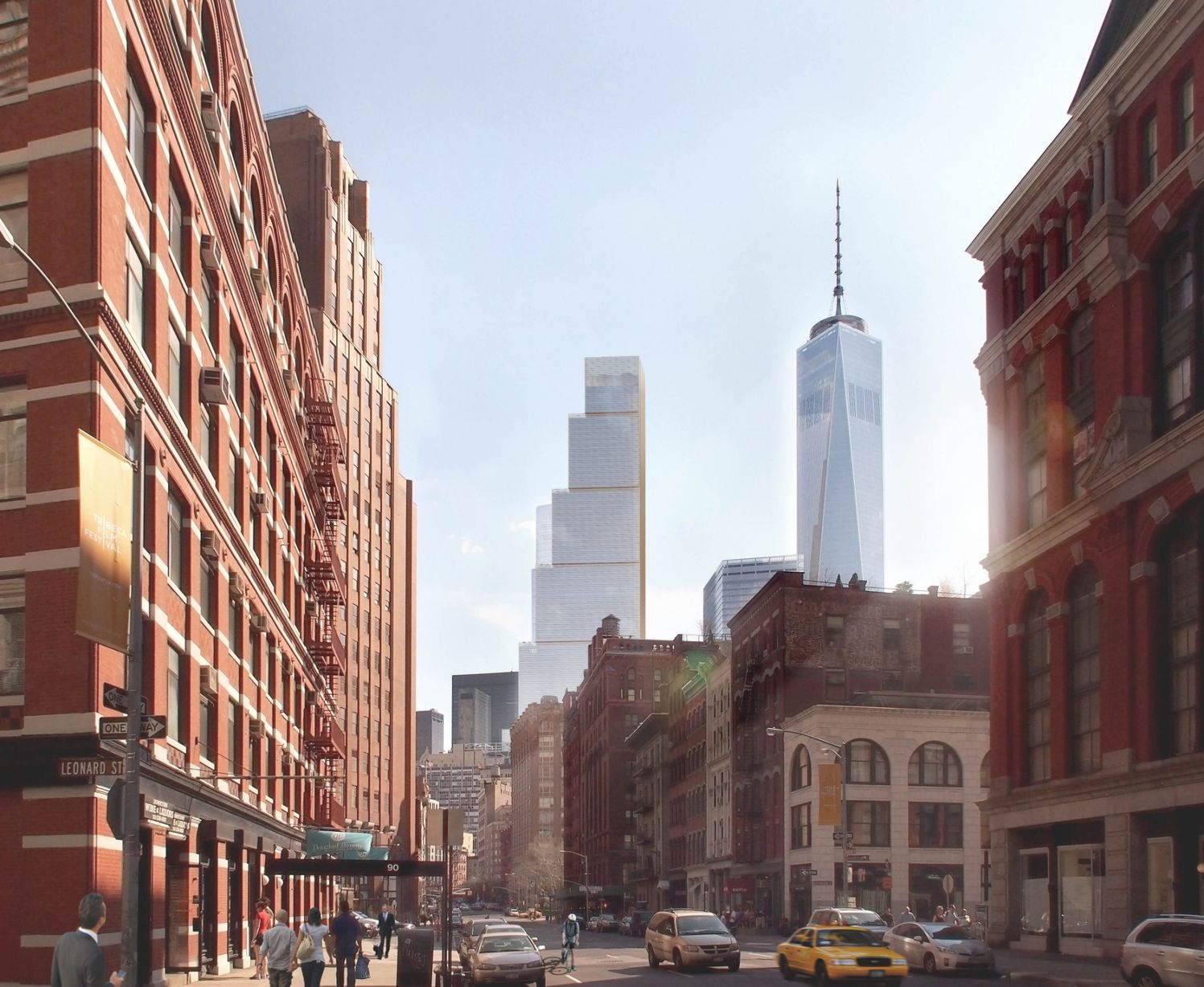
A FRIEND WHO LIVES IN TRIBECA calls this “BIG Photobombs Tribeca.” Bjarke Ingels (the “BI” in “BIG”) calls it uniting “the streetscapes of Tribeca with the towers downtown.”
Since this is my second post in two days about this building, let me point out up front that I’m not saying BIG are bad architects. They’re obviously clever and frequently have interesting ideas. If this building were in Singapore or perhaps the Pudong section of Beijing, I might like it. I might even like it if it were part of Hudson Yards, but in the context of downtown New York, I think it’s an alien intruder.
The buildings in the front of the photo above have human scale, craft, and a simple beauty that comes from composition, rhythm, proportion, and ornament. The deep masonry walls have a play of light and shadow: the result is a firmness and solidity that effectively contain the space between the buildings and shape the street into a comfortable place to be. Together, the buildings make a public realm where we enjoy being and interacting.
Why Is A Private Company Allowed To Close And Design Public Streets?
UPDATE: The good news is that this has been to the Community Boards, which endorsed the plan—I don’t know why I didn’t find that in my searches or calls around this morning. It is good that there is some public process, but I still don’t like ceding the public realm to the control of private developers.
There is a popular theory that the city has decided to spend most public improvement money in the outer boroughs and is actively taking the strategy of letting developers pay for changes in Manhattan. I understand that public spending has not been equitable, but I hope the second half of the sentence is not true, although since I tweeted this morning I’ve heard about a plaza design in Tribeca that may be paid for by a developer, there’s the extra tower height that came in return for the $220 million infrastructure fee collected from the developer of One Vanderbilt, and as I mentioned, the $125 million donation for Diller Park. It does seem like the public realm is for sale. Put them all together, along with the tax places and other subsidies at places like Billionaire Row, and it’s a disturbing trend.
Continue reading
Selling Snow To Eskimos
More proof, if proof were needed, that Starchitects are very good at that.* Daniel Libeskind is even better than Ingels—although Ingels is obviously great at it too.
“Seven Leading Architects Defend the World’s Most Hated Buildings”
Continue reading
The Medium Is The Mechanism
Uber, the world’s largest taxi company, owns no vehicles. Facebook, the world’s most popular media owner, creates no content. Alibaba, the most valuable retailer, has no inventory. And Airbnb, the world’s largest accommodation provider, owns no real estate. Something interesting is happening.
– Tom Goodwin, The Battle Is For The Customer Interface
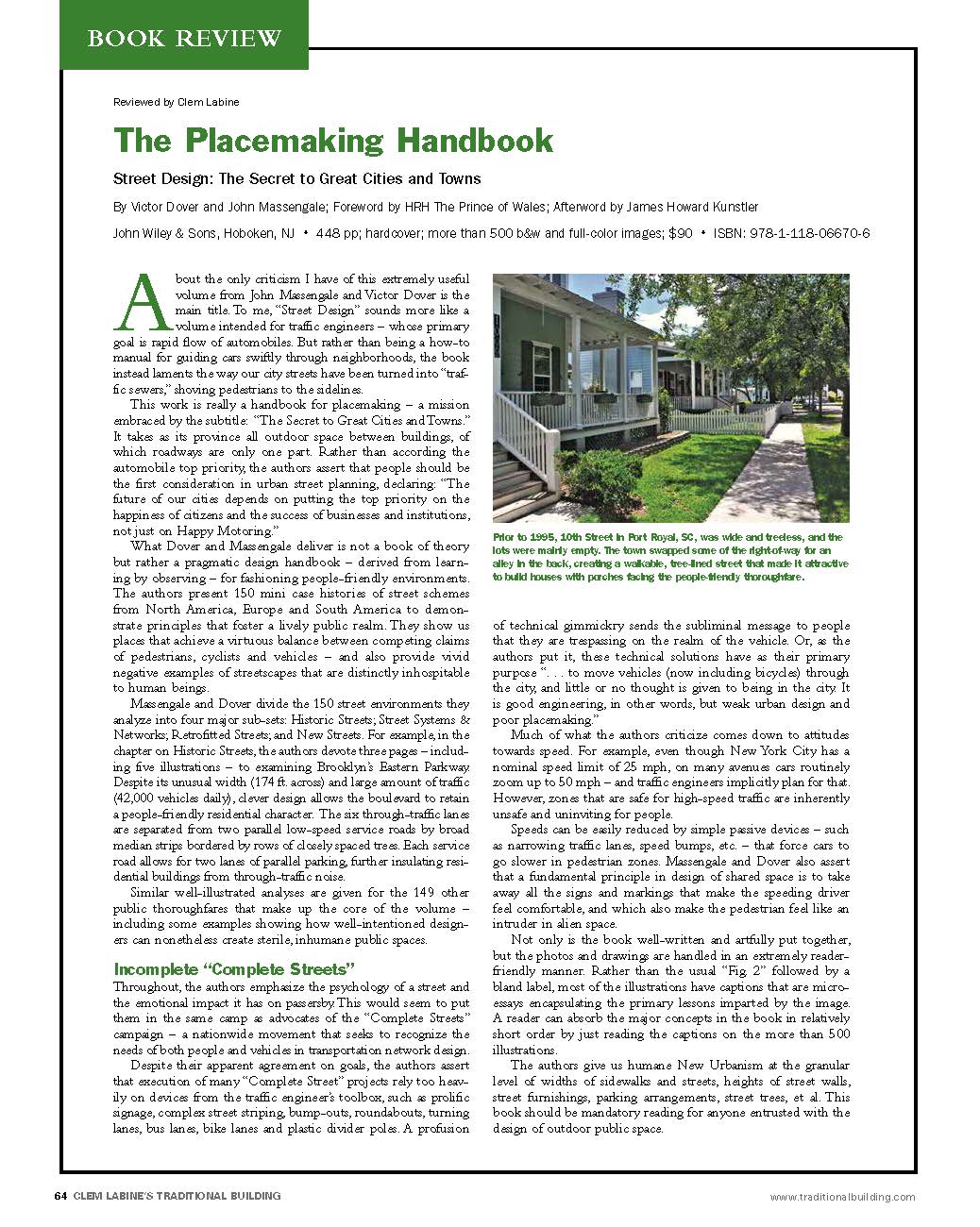
“The Placemaking Handbook”

“This book should be mandatory reading for anyone entrusted with the design of outdoor public space.”
Live from New York
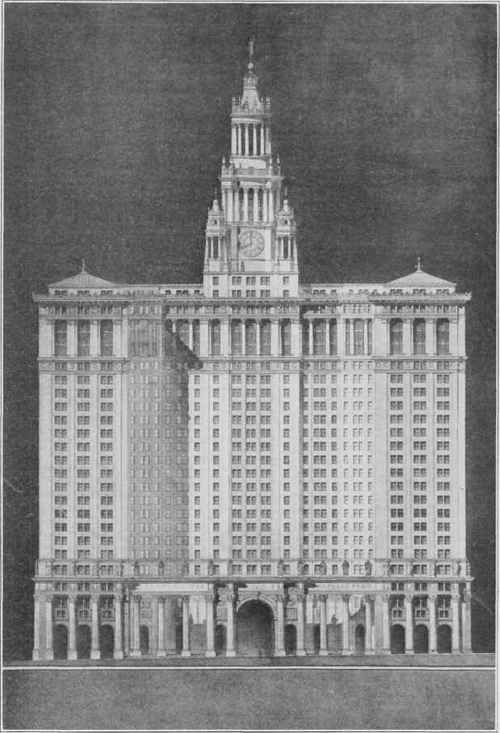
The Good Kind—The New York Municipal Building


McKim, Mead & White, New York Municipal Building, 1 Centre Street, Manhattan, 1907-1914.
ONE-HUNDRED YEARS AGO, when the New York Municipal Building was one year old, McKim, Mead & White were known across the country as the best architects in America (Carrère & Hastings were number two*). They were known as the best, even though McKim and White, the design partners in the firm, were both dead. Continue reading
Everywhere In Manhattan I’ve Ever Lived
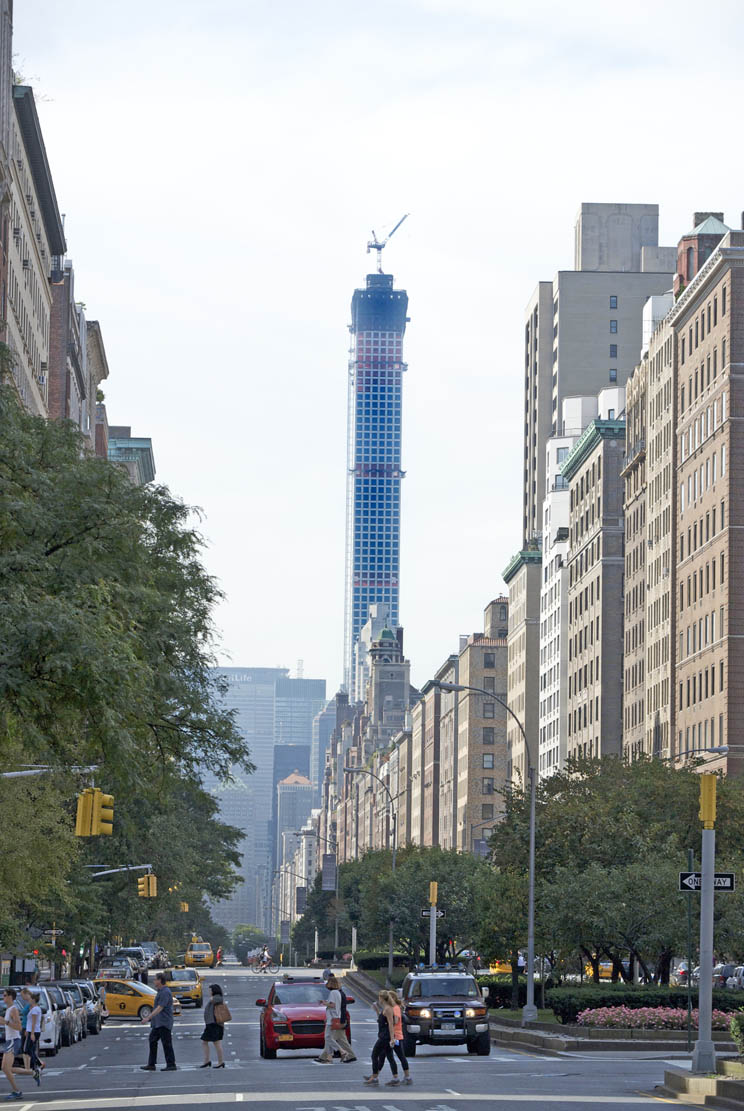
Honestly, isn’t this building giving New Yorkers the finger?
UPDATE: When I first published this quick post in September 2014, for some reason it attracted comments from young architects who not only wanted to defend the building, but who saw my comments as ridiculous. In retrospect, it’s obvious that most New Yorkers, many non New Yorkers, and many architects agreed with me. Some support for that is listed at the end of the post. This month’s Architectural Record on Architecture & Money: The New Gilded Age produces more agreement, particularly in Michael Sorkin’s Too Rich, Too Skinny.
THIS IS Robber Baron 2014 Style: Conspicuous Consumption literally taken to unprecedented heights. You can see it many miles away in Queens, the Bronx, and even Brooklyn, which means millions of New Yorkers have to look at it’s graceless form every day. You get some idea of the problem here (and to a lesser degree here).
And for what? One-hundred and twenty-five apartments on 89 floors (a number that will probably go down as Russian billionaires buy multiple units to combine into large pied-a-terres on the highest floors). Most of the occupants won’t live in the building (What New Yorker would want to live completely surrounded by undistinguished midtown office towers?) and they won’t pay much in the way of local taxes, but their empty nests (called “bullion pots in the sky” in London) will forever disfigure the skyline and steal sunlight as far away as Central Park.
Continue reading
Swedish Streets
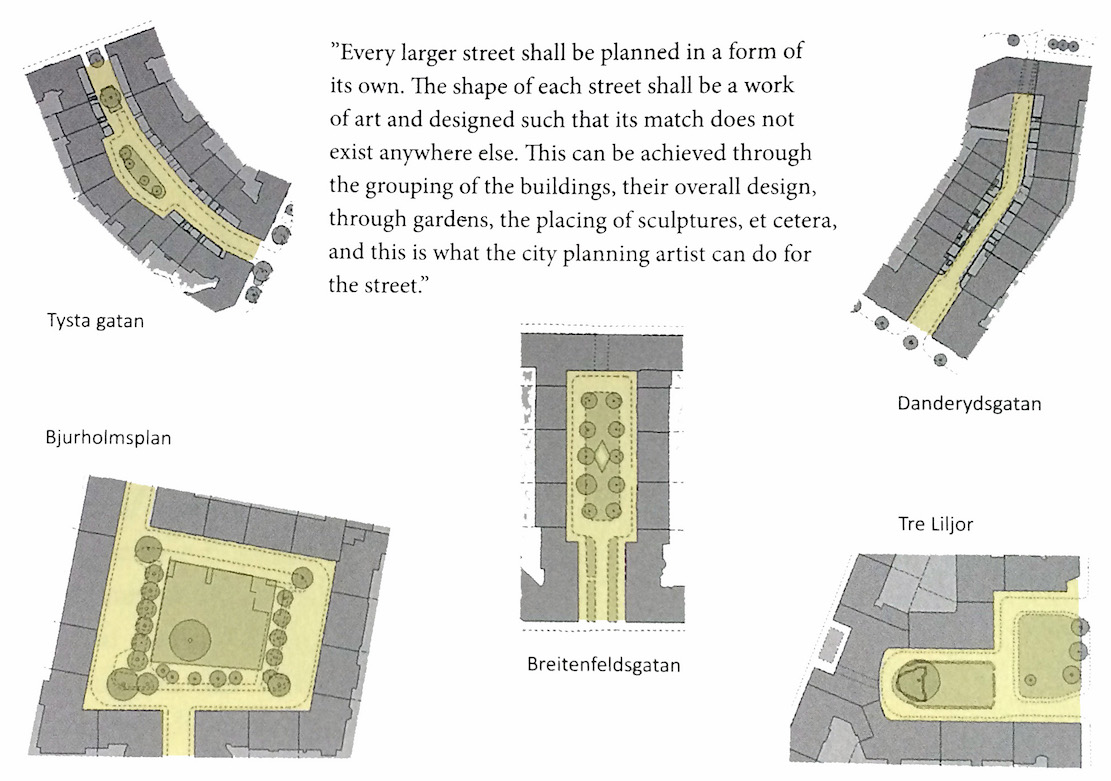
THE EXCELLENT NEW BOOK SWEDISH GRACE has this interesting sidebar:

I’m just starting the book, but it looks great. And note that the streets that look like cul-de-sacs actually connect through the buildings to the next street.
Happy Earth Day — The 21st Century Is The New Sixties?
EARTH DAY reminded me of my old friend Konrad Oberhuber, an art historian at Harvard when I met him, who later became the Curator of the Albertina in Vienna. In 1983 I went on a Fogg Museum trip to Prague with Konrad and others. Czechoslovakia was the first Communist country I visited, and I thought the citizens of Prague were the most oppressed people I had ever seen.
Our group started talking about the mood of the city one day, which led Konrad to tell us about his theory of cycles in history. He had been in Prague during the 1968 democratic protests and the violent Russian crackdown that followd (the Prague Spring – more on this below). The experience contributed to his saying to us that “at the end of 1989 every Communist government in central Europe will fall.” I had never heard anyone say anything like that. At the time, the Reagan administration followed what was known as the Kirkpatrick Doctrine, named after Jeanne Kirkpatrick, the United States’ ambassador to the UN. She said that it was inherent in the nature of the totalitarian governments in Central Europe that they would never voluntarily give up their power unless the United States forced them to. But 6 years later, when every central European Communist government but one peacefully handed over the reins of power between late August and early January, Konrad looked like a genius.
“There are no unsacred places, there are only sacred places and desecrated places’’ — Wendell Berry
Quote of the Day
Mystery City No. 2
Quote of the Day
“On the screens of my sharpest young students are no longer the parametric pinwheels or blobby billows that were a digitally enhanced memory of the last self-consciously curated consensus style, so-called Deconstructivism. Instead it’s all 1986, all the time: James Stirling, Charles Moore, Raimund Abraham, Oswald Ungers, and Aldo Rossi at his most Giorgio de Chirico.”
After the jump, the quote continues…
Continue reading
CLASSICAL CAD
UPDATE: I’M TOLD that Renaissance Revit is a good book:
USING CAD for Classical Architecture is both logical and intelligent—but the image that prompted to write this brief post is ugly, so I put it after the jump, Now I won’t have to look at it every time I go to my blog.
In an interview in Architectural Record, the Chief Technology officer at AutoCAD said, “Instead of creating a form that the computer analyzes according to your criteria, as we do today, you would describe your criteria, and the computer would generate ideas and evaluate them. The computer would then present representative solutions, and you can dive further into these archetypes, change criteria, and add connections. We move from design as a process of dictating to one of discovery.”
Continue reading
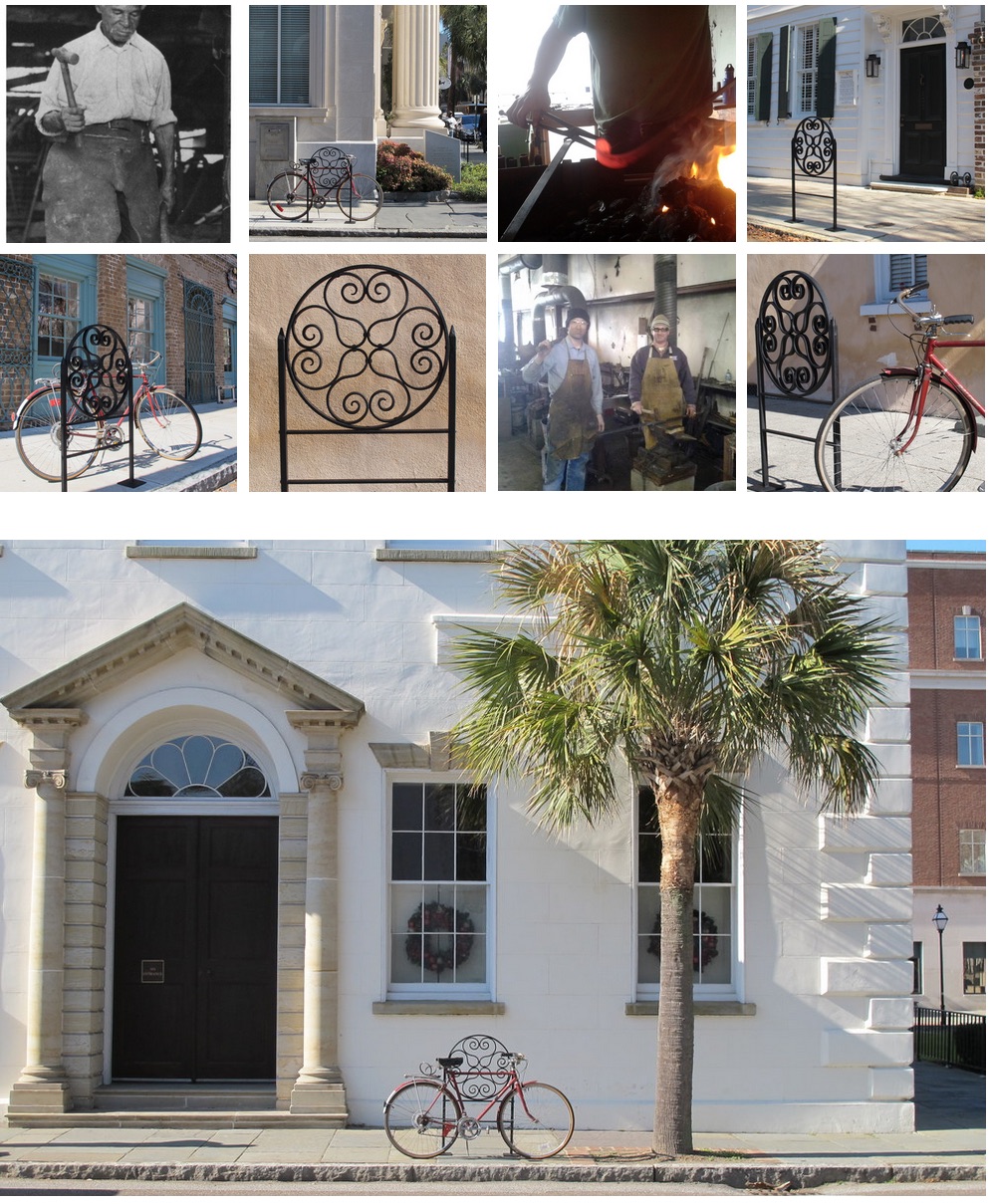
Craft, Beauty, Materials, Local
Craft, beauty, materials, local — these are all words of the moment — but we rarely see them in media stories about architecture, which emphasize shiny glass curtain walls assembled from thousands of identical pieces as mechanically as possible. The walls, by the way, are manufactured in China and shipped to Hong Kong, Shanghai, Mumbai, Dubai, London, New York, and Houston.
That’s what I thought of when I saw these new bicycle stands in Charleston, South Carolina from the craftsman at the American College of Building Arts and the architects Bevan & Liberatos. There’s more information about that here.
After the jump, the opposite approach: